
3D printed jigs, fixtures and production aids
By Layer & Loop Store · Published
Short answer
FDM 3D printing is well suited to jigs, fixtures and production aids: assembly jigs, alignment fixtures, drilling guides, inspection aids and soft workholding. A printed jig can be shaped exactly around your part, made cheaply in one go and improved between versions. It isn't a replacement for engineered metal tooling where there are high forces, heat, heavy wear or safety risks.
What printed jigs and fixtures are used for
- Assembly jigs hold parts in the right place while they are glued, screwed or soldered, so every assembly comes out the same.
- Alignment fixtures line up a label, a component or a cut so it lands in the same spot every time.
- Drilling and marking guides position holes or marks relative to an edge or existing feature.
- Inspection aids give a quick visual or fit check, such as whether a part sits in a nest or a feature reaches a line.
- Workholding such as nests, cradles and soft jaws holds awkward shapes without marking them.
- Small production aids such as packing inserts, cable-forming boards and templates.
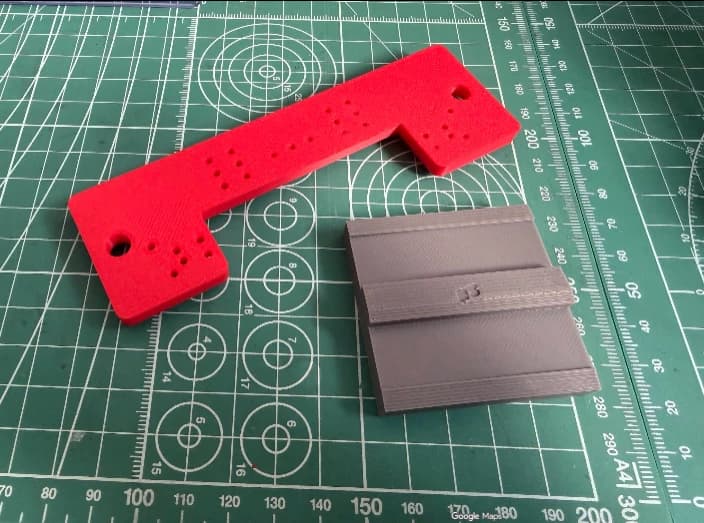
Why 3D printing suits them
A jig has to match one particular part, and it's rarely needed in thousands. That is where printing does well: there is no tooling to pay for, the shape can follow the part exactly (a nest can be made by offsetting the part's own surfaces), and if the first version needs adjusting you change the file and print it again. When a jig works, identical copies for a second bench or a second shift come from the same file.
Repeatable positioning
The point of most jigs is that the part goes in the same way every time. A few design habits make that reliable:
- Locate the part on a small number of definite points or faces rather than a tight all-round pocket, which grips unevenly and binds.
- Leave designed-in clearance in nests and holes — printed holes come out slightly small (see why printed holes come out small).
- Add chamfers or lead-ins so the part drops into place, and relief in the corners so burrs or sharp edges don't stop it seating.
- Make the jig impossible to load the wrong way round if the part isn't symmetrical.
Designing for strength and wear
- Orientation. Printed parts are weakest across their layers, so arrange the print so the main load runs along the layers rather than trying to peel them apart (see print orientation and supports).
- Walls and infill. More walls and higher infill make a stiffer jig. On a Layer & Loop Store quote, Standard and Strong let you set infill from 10% to 100%.
- Shape. Round inside corners with fillets, avoid long thin fingers and thicken the sections that take load.
- Threads. For screws that will be tightened again and again, use heat-set threaded inserts or captive nuts rather than threads printed in plastic.
- Wear points. Where a drill, pin or blade rubs, fit a steel bush or pin and let the printed part do the locating.
Choosing a material
- PLA+ is stiff and holds its shape well, which suits most bench jigs. It softens at fairly low temperatures, so keep it away from heat sources and hot vehicles.
- PETG is tougher and copes with more heat, so it is a good choice for jigs that get knocked about.
- TPU is flexible: useful for soft jaws, pads and nests that must not mark the part.
- PLA-CF and PETG-CF (carbon-fibre filled) are stiffer for their weight, which helps on longer fixtures.
Instant orders are printed in PLA+. The other materials can be requested through a custom order or, for production quantities, Layer & Loop Manufacturing, subject to stock. More on the trade-offs in choosing a material.
The limits of printed jigs
- Accuracy. FDM is good for locating and aligning, but it isn't precision tooling. Layer & Loop Store doesn't guarantee dimensional tolerances.
- Heat. Printed plastics soften well below the temperatures of welding, soldering stations held against them, or hot processes.
- Sustained load. Plastic can slowly deform (creep) under a load left on it for long periods.
- Wear. Repeated sliding or cutting contact wears plastic quickly unless a metal insert takes it.
- Size. A single printed part fits within 250 × 250 × 250 mm; larger fixtures need designing in pieces that are joined (see printing large models in pieces).
- Measurement. A printed check fixture is a quick go/no-go aid, not a calibrated gauge.
Getting jigs printed
Layer & Loop Store prints jigs and fixtures from customer-supplied STL and 3MF files and posts them anywhere in the UK. Order one, or a handful of copies, from the instant quote to test the design. Jigs needed for a production line in larger numbers, or made again and again to the same specification, can go through Layer & Loop Manufacturing, the manufacturing service from Layer & Loop Store, with an approved sample first where it helps (see production samples and sign-off).
Common questions
Are 3D printed jigs strong enough?
For locating, aligning and holding parts by hand, a well-designed FDM jig usually is. Strength depends on the design, the material, the infill and the print orientation, and printed parts are weakest across their layers. They are not a substitute for engineered tooling where high forces, heat or safety are involved.
Can I 3D print a drill guide?
Yes, for positioning a drill, especially on wood and plastics. Plastic wears quickly where a drill bit rubs, so for repeated use the usual approach is to press or glue a hardened steel drill bush into the printed guide and let the print do the locating.
Can Layer & Loop Store design a jig for me?
No. Layer & Loop Store prints customer-supplied STL and 3MF files and doesn't offer a design or CAD service. The jig needs to be designed by you or your designer; Layer & Loop Store can then print one to test and further copies when it's right.
Test your jig design
Upload your STL or 3MF for an instant price on one or a few copies, then order more once it's right.